
A month ago, I used Claude to build a classroom simulation I originally built as a chatbot 2 years ago. While I was deciding what I wanted my students to get out of the new version, I noticed an assumption I had inadvertently been perpetuating. The activity, like most of the adoption research it draws on, treated getting teachers to use a new tool as the goal, and a teacher’s concerns about the tool showed up as obstacles to work around.
A quick rebuild with Claude gave me the head space to think more broadly about what I was designing. That thinking led me back to educational technology adoption literature. and ask “what is up with the uncritical assumptions in our adoption literature??”
Designing the Tool
In this doctoral course (Education, Society, and Technology), students read about technology adoption: the Technology Acceptance Model (TAM), the Unified Theory of Acceptance and Use of Technology (UTAUT), Diffusion of Innovations, the Concerns-Based Adoption Model (CBAM), and the research on first- and second-order barriers.
About two years ago I built a custom GPT to help them apply those models. It presented a school rolling out an AI lesson-planning tool, offered strategies at each step, and asked students to “explain why your choice would increase adoption.”
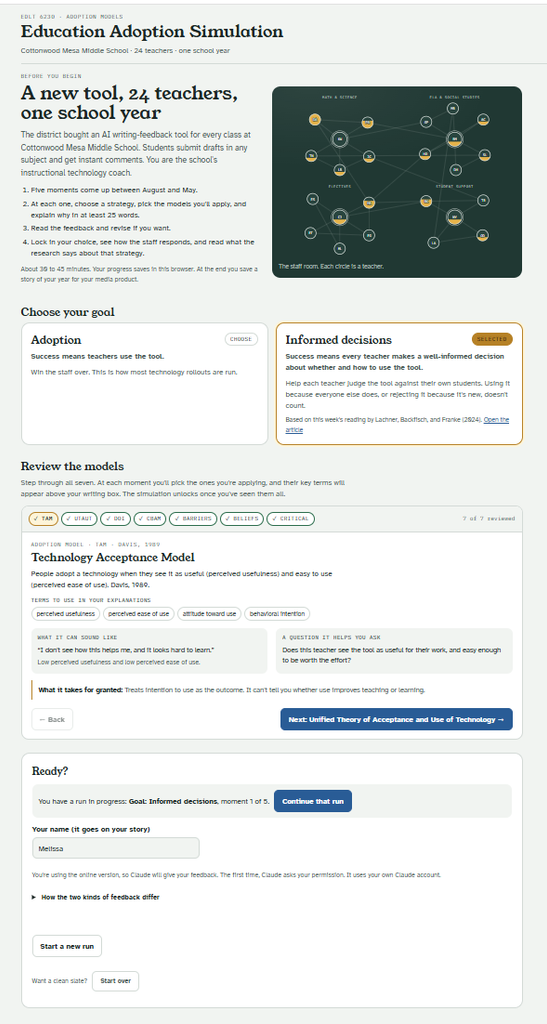
This fall I lost access to the GPT’s prompt, so I spent a few hours rebuilding the activity with Claude as an interactive web app. Claude wrote the code and drafted the scenarios and the teachers’ lines. That allowed me to focus on the pedagogical goal of the simulation.
The seed for this came from a new reading I assigned my class. Lachner and colleagues argue that technology integration should be judged by its quality and its effects on students’ learning. They point out that research using TAM “mainly focusses on the teachers’ general acceptance and intention to use technology,” which says nothing about whether that technology improved teaching or learning.
When the first working version of my simulation described “success” as increasing the number of teachers using the tool, and framed teachers who pushed back as problems to solve, I realized my simulation never asked how the tool affected students’ learning. Once I started thinking about the effect on students, I found myself going a step further: Lachner et al. still framed adoption as the goal, but if a tool might not help some students, or might harm them, then the best decision for some teachers could be not to use it.
I told Claude the simulation “tends to assume that it will be good to adopt.” I meant the app, but I realized the same was true of the technology adoption literature as a whole. TAM and UTAUT predict intention to use. Diffusion of Innovations calls the last group to adopt “laggards.” Barriers research treats whatever keeps a teacher from using technology as something to remove. Everett Rogers (2003) even named the problem “pro-innovation bias,” the assumption that an innovation should spread to everyone.
Making Meaning Through Design
Designing the next version gave me a way to explore these perspectives and build them into the activity. The new version gives students a choice of goals. One is the familiar adoption goal. The other is informed decisions, where success means each teacher makes a well-informed choice about whether and how to use the tool, and a teacher who looks closely and decides against it still counts as a success. I also swapped the tool for an AI writing-feedback tool used across subjects, so the honest answer to “Should this teacher use it?” changes across content areas and contexts. Giving students a choice of goals pushes them to think critical about technology adoption: they have to decide what counts as success before they start.
Punya Mishra and Matthew Koehler built the TPACK framework on the idea that teachers develop their understanding of technology, pedagogy, and content together, through design. That has always been how I come to understand things as a teacher educator. What was different this time is how much of the production work AI took on. With the code and the scenario writing handled, nearly all of my design time went to questions of meaning: what counts as success, which tool the fictional staff should consider, and whose outcomes the simulation should track.
What the Research Does With Concerns
Once I’d seen the assumption in my own activity, I wanted to know how common it is in current research, so I asked Claude to help me take a quick look. We started from a recent systematic review of research on teachers and generative AI by Ayubian et al. (2026), which includes 105 empirical studies, and Claude coded each study’s abstract by how it framed adoption.
Here are results from a quick analysis. Claude was the only coder, it worked from abstracts, and about ten of its calls could reasonably have gone either way. Even so, it is an interesting way to explore this question.
Who decided a concern was a “barrier”?
In research on how teachers adopt technology like AI, a teacher’s concern is usually labeled a “barrier”, something to get past on the way to using the tool. Whether the concern is legitimate is rarely the question.
Most studies of teachers and AI treat adoption as the goal
Each square is one of the 105 studies in a 2026 systematic review of research on teachers and generative AI, sorted by how its abstract frames teachers’ use of AI.
Of the 40 studies that name a concern, most treat it as a “barrier”
Stack up the 25 concerns labeled this way and you get a wall
Each labeled brick is one study, named for a concern in its abstract.
Each brick is a question a teacher would want answered. In most studies, it becomes a “barrier” to get past.
62 of the 105 studies treat adoption as the goal. Success means teachers accept AI, intend to use it, or feel ready to integrate it. Another 35 take use as given and study how teachers use AI or what it does. Only 5 treat whether to use AI as an open question.
Forty of the studies name a concern about AI, such as harm to student learning, privacy, over-dependence, or bias. In 25 of those, the concern is handled as a “barrier” on the way to adoption. In one study, faculty who worried that ChatGPT would hurt their students’ learning were less likely to plan to use it, and the authors recommend addressing these “psychological barriers” to make integration easier (Verano-Tacoronte et al., 2025). In another, teachers who saw more risk in AI accepted it less, and the recommendations include strategies to “minimize perceived risks” (Wut et al., 2025).
In this framing, a concern is something to get over. Whether the teacher is right, whether ChatGPT does hurt those students’ learning, is not addressed.
Similarly, in a recent article, Niral Shah and colleagues argued that education tends to default to optimism about new technology, even among critics worried about inequity, and that refusal is rarely treated as a legitimate response.
When a teacher raises a concern about a new tool, can we ask whether the concern is appropriate before we ask how to get past it? Some concerns will turn out to be misunderstandings. Others are reasons to slow down, like a feedback tool that comments differently on English learners’ writing than on everyone else’s.
I rebuilt the simulation, ran the quick analysis of the research, made the infographic, and drafted this post with help from Claude.